
Cooling solutions
Immersion Cooling Hosting
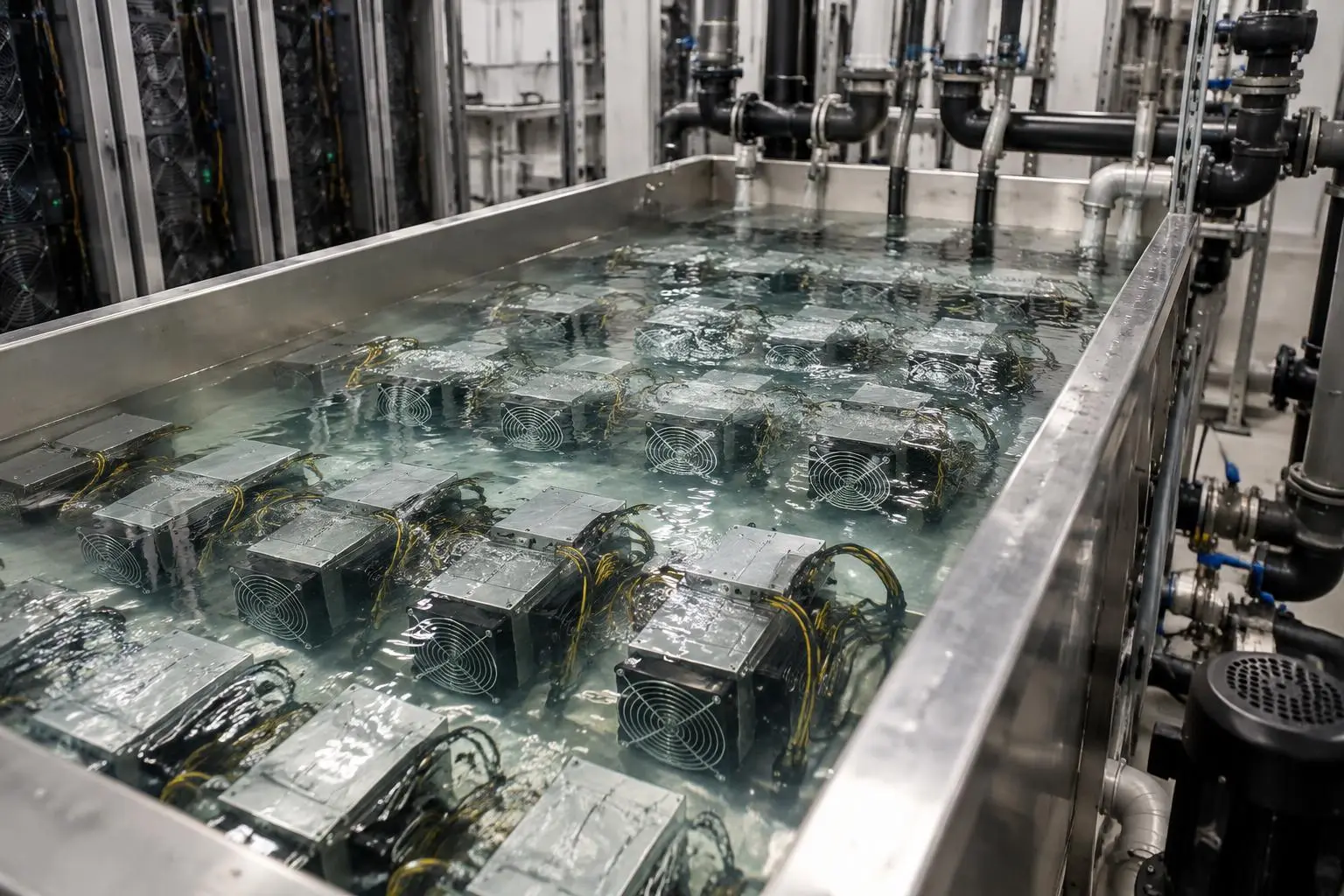
Miners submerged in dielectric fluid for exceptional thermal stability, reduced dust exposure and the potential for optimised performance.
How it works
Dielectric fluid immersion tanks
In immersion cooling, miners have their fans removed and are placed in tanks filled with a non-conductive dielectric fluid. Pumps circulate the warm fluid to heat exchangers, where heat is transferred to an external cooling loop and rejected outdoors.
With no air contact, components are protected from dust and humidity.
- Single-phase dielectric fluid tanks
- Circulation pumps and piping
- Plate heat exchangers
- External dry coolers

Considerations
Is immersion right for you?
Immersion suits operators who want maximum temperature stability or plan to tune miners for higher efficiency or performance. Miners need preparation (fan removal and firmware settings) before going into tanks. Our team handles this during installation.
Benefits of immersion
Thermal stability
Very consistent chip temperatures year-round.
Hardware protection
No dust, reduced humidity and oxidation exposure.
Tuning potential
Headroom for optimised firmware profiles where supported.
How single-phase immersion cooling works
In a single-phase immersion system, dielectric fluid carries heat away from submerged mining hardware without boiling. The process below follows that heat from the miner to the outdoor air. Two-phase systems use a different internal process: fluid boils at hot components, then condenses for reuse.
- 01
Prepare the miner and remove fans
Check the miner’s condition, clean away dust, and verify that its components and materials are compatible with the intended fluid. Remove air-cooling fans where the approved conversion procedure requires it. Confirm how firmware handles missing fans, and check whether the power supply can be submerged or needs separate cooling.
- 02
Submerge the miner in the tank
Place the prepared miner in its designated position, with connections and service clearances arranged for the tank design. Fill or lower the unit into the specified dielectric fluid. Maintain the required immersion depth and allow trapped air to escape before operating the equipment.
- 03
Circulate fluid through the equipment
A pump circulates fluid through the tank and across heat-producing components. Tank layout and flow distribution matter: fluid that bypasses the hashboards cannot cool them effectively. Monitor temperatures and flow conditions rather than assuming that a submerged miner is automatically receiving adequate cooling.
- 04
Transfer heat through a heat exchanger
Heated dielectric fluid passes through a heat exchanger, transferring energy to a separate coolant circuit without intentionally mixing the two liquids. The exchanger must accommodate the planned heat load, fluid properties, flow rates, and temperature differences between the circuits.
- 05
Reject heat through a dry cooler
The secondary coolant carries heat to an outdoor dry cooler, where fans move air across a finned coil. Cooled liquid returns to the heat exchanger. Outdoor temperature affects performance, so sizing must account for demanding weather conditions, not just favorable operating days.
Dielectric fluids: single-phase versus two-phase
A dielectric fluid is formulated to resist electrical conduction while transferring heat from energized equipment. That does not make every insulating liquid suitable for ASIC miners. Fluid selection must account for electrical properties, thermal performance, fire characteristics, and compatibility with circuit boards, connectors, cable insulation, seals, and thermal interface materials. Contamination can change fluid behavior over time. Water, particles, and substances released by incompatible materials may compromise performance, so product specifications and equipment approvals matter more than a generic label such as “immersion oil.” Never substitute an unapproved fluid solely because its initial purchase price is lower.
Single-phase fluids remain liquid throughout normal operation and transport heat through circulation. Two-phase fluids boil at component surfaces; the resulting vapor transfers heat to a condenser and returns as liquid. These approaches require different tanks, controls, fluid-handling procedures, and containment arrangements. Compare viscosity at operating temperature, heat capacity, thermal conductivity, dielectric strength, and material compatibility. For single-phase fluids, flash point and oxidation stability also deserve attention; for two-phase fluids, boiling characteristics and vapor management are central. Review the safety data sheet, environmental handling requirements, and disposal pathway before choosing either system. A fluid change should be treated as an engineering decision, not routine replenishment.
Tanks and heat rejection must be sized together
An immersion tank is more than a container sized to fit a collection of miners. Its layout must deliver fluid to the components that need cooling while avoiding stagnant regions and excessive bypass flow. Useful design considerations include working fluid volume, equipment spacing, inlet and outlet placement, cable routing, drainage, spill containment, and access for lifting miners. Pumps, seals, and piping must suit the selected fluid. Service access also matters: a tank that is tightly packed may be difficult to inspect or maintain without disturbing neighboring equipment. Physical fit alone does not establish a safe operating configuration.
The cooling system must ultimately reject approximately the electrical power consumed by the miners as heat, with relevant auxiliary loads included in the design. Tank capacity, pump flow, heat-exchanger performance, and dry-cooler capacity therefore need to be evaluated as one system. A dry cooler depends on the temperature difference between its coolant and outdoor air; it cannot independently cool that coolant below ambient dry-bulb temperature. Hotter weather reduces available temperature margin. Ask how the design handles peak conditions, partial flow loss, and equipment shutdowns, including the thresholds used to reduce mining power before temperatures exceed equipment or fluid limits.
Overclocking: cooling headroom is not electrical headroom
Immersion can improve heat removal, but lower chip temperatures do not establish that a miner can safely run above its rated settings. Overclocking headroom also depends on chip variation, voltage regulation, power-supply limits, connectors, cabling, and the electrical circuit feeding the machine. Additional mining power increases the heat that the entire cooling loop must handle. Evaluate measured hashrate, hardware errors, temperatures, and total power together. A higher hashrate can coincide with worse efficiency, commonly expressed as joules per terahash. Compare stable operation under realistic conditions rather than relying on a brief peak result from an aggressive profile.
Firmware must support the exact hardware revision and intended operating mode. Third-party firmware may introduce licensing fees, security concerns, altered protections, or warranty restrictions; immersion conversion itself may also affect coverage. Check the manufacturer’s current terms before removing fans or changing settings. A responsible tuning plan starts with a documented baseline, makes incremental changes, and defines rollback conditions for errors, instability, or excessive power draw. Evaluate any projected benefit against additional energy use, firmware costs, and hardware risk. Mining revenue is not guaranteed, and extra hashrate does not guarantee better net returns. Hosting prices are quote-only; no universal immersion rate should be assumed.
Compatibility starts with the exact miner configuration
An ASIC miner should not be considered immersion-ready simply because it fits inside a tank. Confirm the exact model, hardware revision, dimensions, electrical requirements, power-supply arrangement, and firmware behavior. Air-cooled equipment may need fan removal and an approved way to handle fan monitoring, while some materials may require additional compatibility review. Hydro-cooled miners use a different heat-transfer arrangement and should not be treated as interchangeable with immersion equipment. Use the supported miner reference as a starting point, then verify the proposed configuration before shipping or modifying hardware. A model-family name alone is not enough to resolve every compatibility question.
The WhatsMiner M66S is an immersion-oriented model, but that designation does not eliminate system-level checks. Verify the particular unit’s published specifications, recommended operating conditions, fluid requirements, and installation instructions against the proposed tank and electrical design. Consult WhatsMiner’s manufacturer information for current documentation rather than applying preparation instructions intended for an air-cooled model. For any miner, record its serial number, baseline operating condition, and existing faults before installation. Also establish how warranty returns would be handled after fluid exposure, including any cleaning or packaging requirements. This helps separate preexisting issues from conversion, transport, or operating problems.
Maintenance includes fluid, filtration, and safe miner removal
Immersion removes the miner’s dependence on its original air-moving fans, but it does not eliminate maintenance. Fluid checks should follow the fluid supplier’s guidance and the system’s operating conditions. Track level, temperature, visible changes, leaks, and evidence of contamination; use laboratory testing where specified to assess properties that visual inspection cannot establish. Filtration should target the expected contaminants without creating excessive flow restriction. Monitor filter condition and pressure drop where instrumentation is provided. Check pumps, connections, seals, and heat-exchanger performance alongside the miners themselves. Avoid mixing fluids or adding cleaning agents unless compatibility has been explicitly established.
Removing a miner requires a planned service procedure. Shut it down, isolate electrical power, and follow applicable lockout procedures before disconnecting or lifting it. Allow for hot fluid, equipment weight, drainage, and spill containment. Use suitable lifting equipment where needed, and let fluid drain into an appropriate collection area rather than carrying a dripping unit across the workspace. Cleaning methods must suit both the fluid and the hardware; an arbitrary solvent can damage components or leave residue. Before returning the miner to service, inspect connections, confirm its condition, and recheck operation. The miner monitoring and maintenance guide provides related operating context.
FAQ
Common questions
Does immersion void my warranty?
It can, depending on the manufacturer. Check your warranty terms before choosing immersion.
Can my miner go back to air cooling later?
Generally yes, after cleaning and refitting fans, though we recommend discussing this before installation.
Do you guarantee mining revenue?
No. We provide hosting infrastructure and services. Mining revenue depends on network difficulty, coin prices and hardware efficiency, which are outside our control.
Does immersion cooling make a mining installation silent?
No. Removing miner fans can reduce a major source of noise, but the cooling system still uses mechanical equipment. Circulation pumps and dry-cooler fans produce sound, and their contribution depends on equipment selection, operating speed, and installation layout. Assess noise for the complete system rather than treating fanless miners as evidence of a silent installation.
What happens if fluid circulation stops?
Heat removal can deteriorate quickly even though the miners remain submerged. Fluid volume provides some thermal buffering, but it is not a substitute for circulation. A suitable protection strategy uses relevant flow and temperature signals to reduce power or shut down equipment. The appropriate thresholds depend on the miner, fluid, tank layout, and cooling-system design.
Can heat from an immersion system be reused?
Potentially, but a useful heat-recovery project needs a nearby demand that matches the available temperature and operating schedule. A heat exchanger can separate the mining cooling loop from the receiving system. Additional equipment may be necessary if higher temperatures are required. Heat reuse should not remove the ability to reject heat safely when the receiving system is unavailable.
Does a dry-cooler immersion system consume water through evaporation?
A conventional dry cooler rejects heat through a coil to outdoor air without relying on water evaporation. Its secondary loop still contains coolant and requires leak checks and appropriate fluid maintenance. Designs with adiabatic assistance or evaporative equipment differ and may consume water. Confirm the actual heat-rejection configuration rather than assuming all immersion systems have the same water requirements.
Ready to Host Your ASIC Miners?
Share your equipment details and our team will prepare a customised hosting quotation.